

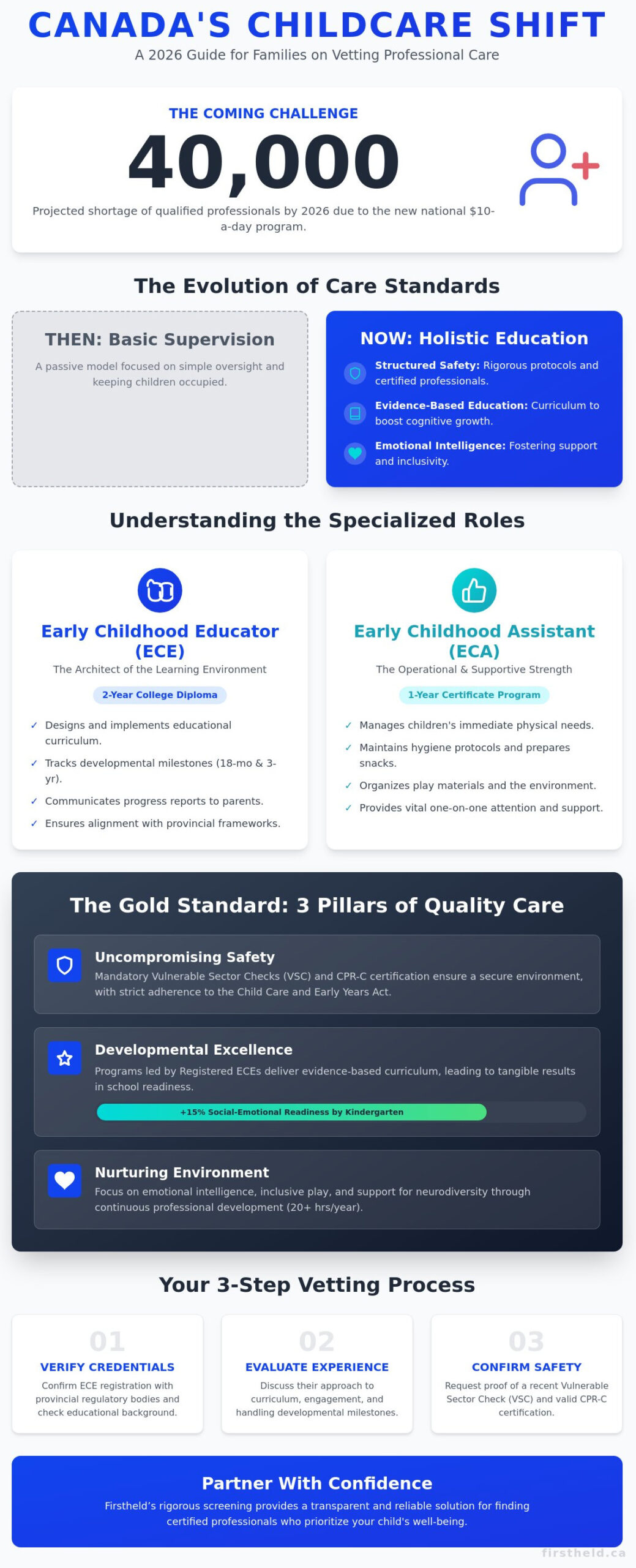
By 2026, Canada’s childcare sector will face a projected gap of 40,000 qualified professionals as the national $10-a-day program reaches full implementation. This surge in demand makes finding reliable care for kidz feel like an uphill battle for families across the country.
You want the best for your family, yet the terminology around certifications like Early Childhood Educators (ECE) and Early Childhood Assistants (ECA) often feels like a confusing maze. It’s natural to feel anxious about whether a caregiver is truly vetted or just filling a seat in a crowded room. We’re here to provide the clarity you need to choose with confidence. You’ll discover the specific markers of high-quality professional care and learn how to ensure your children are supported by experts who meet the highest provincial standards.
This guide outlines a practical framework for vetting staffing solutions and explains the essential roles that define modern Canadian childcare.
Key Takeaways
- Understand the evolution of professional care for kidz as it shifts from basic supervision to holistic early childhood education tailored for the Canadian landscape.
- Learn the critical differences between Early Childhood Educators (ECEs) and Assistants (ECAs) to ensure your child has the right level of specialized support.
- Identify the core pillars of quality—safety, engagement, and environment—that define the modern gold standard for inclusive development.
- Discover a simple, step-by-step process to verify credentials and evaluate caregiver experience against the specific needs of your family.
- Explore how Firstheld’s rigorous screening process provides a transparent and reliable solution for finding certified professionals who prioritize your child’s well-being.
Defining Professional Care for Kidz in the Modern Era
Professional care for kidz in 2026 represents a total departure from the passive supervision models of the past. It’s a holistic service that merges physical safety with structured learning and emotional intelligence. In Canada, the industry has shed the outdated babysitting label. We now recognize these services as essential early childhood education. This shift ensures that children between the ages of 0 and 5 receive the cognitive stimulation they need during peak brain development years. For a deeper look at the foundations of this field, you can explore this Early Childhood Education Overview which outlines the developmental domains addressed in modern programs.
The 2026 standard focuses on three core pillars: safety, education, and emotional support. This approach isn’t just about keeping children occupied. It’s about building a foundation for long-term success. Success in this sector requires a partnership between four key stakeholders:
- Parents: They act as the primary advocates for their child’s unique needs.
- Facilities: Licensed centers provide the regulated environment required for growth.
- Staffing Agencies: These organizations vet and provide the certified talent that drives quality.
- Government Regulators: They set the benchmarks for safety and curriculum.
The Evolution of Childcare Standards
The move toward professionalization accelerated significantly following the 2021 launch of the Canada-Wide Early Learning and Childcare (CWELCC) system. By 2026, 100% of provinces have integrated national quality frameworks that prioritize child outcomes over simple convenience. These standards provide parents with peace of mind by ensuring every licensed space follows a rigorous curriculum. Caregivers now participate in mandatory continuous professional development. In many provinces, this includes a minimum of 20 hours of annual training in areas like inclusive play and neurodiversity. This commitment to growth ensures that care for kidz remains adaptive and evidence-based.
Why Certification Matters
Certification is the bridge between basic supervision and developmental excellence. Data from 2025 indicates that children in programs led by Registered Early Childhood Educators (RECEs) show a 15% increase in social-emotional readiness by the time they enter kindergarten. Professional certifications also bake safety into the daily routine. These protocols include mandatory CPR-C certification and strict adherence to the Child Care and Early Years Act. Security is non-negotiable. Every professional must pass a Vulnerable Sector Check (VSC) before entering a classroom. This transparent screening process eliminates guesswork for families and prioritizes child safety above all else.
Understanding the Specialized Roles: ECEs vs. ECAs
Canadian childcare standards in 2026 demand a clear division of labor to ensure safety and educational quality. Providing high-standard care for kidz requires a blend of pedagogical leadership and consistent practical support. While both roles are essential, their educational paths and daily tasks differ significantly. In Canada, an Early Childhood Educator (ECE) typically completes a two-year college diploma. They must also register with provincial regulatory bodies, such as the College of Early Childhood Educators in Ontario. Early Childhood Assistants (ECAs) generally complete a one-year certificate program, focusing on the fundamental aspects of child supervision and care.
The Daily Impact of an ECE
ECEs act as the architects of the learning environment. They use their expertise to design and implement curricula that align with provincial frameworks like “How Does Learning Happen?”. Their work involves more than just supervision. They analyze the Roles of an Early Childhood Educator to create age-appropriate activities that spark cognitive and social growth. ECEs are responsible for tracking 18-month and 3-year developmental milestones. They provide the professional bridge between the classroom and the home by delivering detailed progress reports to parents. Their leadership ensures the facility meets every pedagogical standard required by law.
The Vital Support of an ECA
ECAs provide the operational strength that keeps a classroom running smoothly. While the ECE focuses on the curriculum, the ECA manages the immediate physical needs of the group. This includes preparing nutritious snacks, maintaining strict hygiene protocols, and organizing play materials. They offer vital one-on-one attention to children who might need extra help during group transitions. By keeping the environment clean and sterilized, they reduce the spread of illness in high-traffic centers. Their presence ensures that no child is left without supervision while the lead educator handles administrative or specialized tasks.
Choosing the Right Mix for Your Facility
Staffing a childcare center requires a strategic approach to ratios. Provincial regulations, such as the Child Care and Early Years Act, dictate specific staff-to-child numbers. For example, a toddler room often requires a 1:5 ratio, while a preschool room might operate at 1:8. A balanced facility uses ECEs to set the educational tone and ECAs to maintain the daily rhythm. If you’re looking to expand your team or upgrade your facility to meet 2026 standards, exploring flexible funding solutions can help you secure the right talent. This investment ensures your center remains compliant and competitive. The ECE/ECA partnership is the backbone of Canadian childcare.
The Essential Standards of High-Quality Childcare
Quality childcare relies on three non-negotiable pillars: safety, engagement, and environment. High-quality care for kidz ensures that every child, regardless of their physical or cognitive ability, receives tailored support. By 2026, Canadian federal mandates require that 100% of licensed providers implement inclusive care frameworks. This shift ensures that children with diverse needs aren’t just present but are actively participating in all activities. Many families worry about the expense of these high standards, but the national C$10-a-day childcare initiative has decoupled high quality from high out-of-pocket costs. Professionalism is now the baseline, not a premium add-on.
Safety and Health Protocols
Safety is the foundation of trust. Professional caregivers must hold valid Level C CPR and First Aid certifications, with mandatory recertification every 12 months. Sanitation strategies have evolved beyond basic cleaning; 2026 standards require documented three-step disinfection cycles for all shared surfaces and toys. Emergency preparedness involves monthly drills for various scenarios, including fire and lockdowns. In Ontario, any incident must be reported through provincial portals within 24 hours to ensure total transparency. These protocols create a secure bubble where children can explore without risk.
Engagement and Emotional Support
Responsive caregiving is about more than supervision. It’s about building secure attachments that allow children to feel safe enough to learn. Professional staff manage behavioral challenges with empathy rather than punishment. They use co-regulation techniques to help children navigate big emotions. This approach follows the Professional Standards and Competencies which highlight that emotional safety is the primary driver of cognitive growth. Play-based learning is the vehicle for this development, turning everyday interactions into opportunities for social growth and problem-solving.
Environmental Excellence
A high-quality physical environment adapts to the child’s age. For infants, this means plenty of floor time in zones free of older children. For preschoolers, it involves specialized sensory equipment and “loose parts” play materials that encourage creativity. These spaces must provide at least 3.5 square meters of unobstructed floor space per child to prevent overcrowding. Professional staffing agencies play a vital role here by providing educators who are trained to optimize these environments. You can refer to Healthcare Staffing Agencies in Ontario for insights on how rigorous vetting and specialized training standards are applied across the broader care sector. When the staff is professional, the care for kidz becomes a transformative experience rather than just a service.
How to Evaluate and Choose the Right Caregivers
Selecting the right care for kidz is a significant decision for any Canadian family. It requires a disciplined vetting process to ensure your child’s safety and development meet 2026 standards. Start by verifying credentials through provincial regulatory bodies, such as the College of Early Childhood Educators in Ontario. Confirm their standing is active and clear of any past disciplinary actions. It’s not enough to see a certificate; you must validate it against the current registry.
Next, assess their specific experience levels. A caregiver with 10 years of experience in a large daycare setting might not have the specific skills needed for one-on-one infant care. Match the candidate’s background to your specific household needs. Conduct interviews using scenario-based questions rather than simple yes or no inquiries. Ask how they’d handle a sudden C$200 emergency or a specific behavioral challenge. This reveals their problem-solving skills under pressure.
Always check at least three professional references from the last five years. Focus on their performance in environments similar to yours. Once hired, monitor the first 14 days closely. Look for subtle changes in your child’s mood or behavior. A child’s non-verbal cues often tell you more about the quality of care than a resume ever could. For families seeking the highest standards of professional support, our comprehensive care for kids guide provides detailed frameworks for evaluating both educational and health-focused caregiving approaches.
Vetting Beyond the Resume
Paperwork only tells half the story. During the interview, watch how the candidate interacts with your child. Do they get down to the child’s eye level? Do they initiate engagement or wait to be prompted? Professional agencies handle the heavy lifting here. They perform background checks and verify certifications before you even meet the candidate. This typically saves families roughly 20 hours of administrative work per hire.
The Role of Staffing Agencies
Agencies ensure the care for kidz remains consistent even during unexpected staff shortages. They provide a reliable supply of vetted professionals, which is vital if your primary caregiver is unavailable. They offer a safety net for last-minute or emergency coverage that private hires cannot match. For a detailed breakdown of what to look for in a provider, refer to our guide on Staffing Agencies in Toronto for vetting checklists.
If you’re looking to manage the costs of premium childcare by leveraging your home’s value, access your home equity today for immediate financial flexibility.
Firstheld Healthcare: Your Partner in Professional Childcare
Firstheld Healthcare provides a distinct advantage by merging healthcare precision with early childhood expertise. We recognize that the highest standards of care for kidz require more than just supervision; they demand a clinical level of safety combined with pedagogical warmth. Our unique approach treats childcare staffing with the same urgency and rigorous vetting found in hospital environments. This ensures every educator we place is prepared for both daily lessons and emergency situations. Facility managers across Canada trust us to deliver professionals who understand the nuances of the 2026 regulatory landscape.
Our dual focus on healthcare and education eliminates the common risks associated with generalist staffing agencies. We vet every Early Childhood Assistant (ECA) and Early Childhood Educator (ECE) through a 10-point verification protocol. This process includes mandatory Vulnerable Sector Checks, up-to-date immunization records, and valid Standard First Aid with CPR Level C. By prioritizing these medical and safety benchmarks, we allow daycare owners to focus on their curriculum while we handle the complexities of compliance and risk management.
Our Commitment to Quality Care
We select our Registered Early Childhood Educators (RECE) based on their ability to lead with both head and heart. Every candidate must hold a valid registration with the College of Early Childhood Educators (CECE) or their respective provincial body. We don’t just check diplomas; we conduct behavioral interviews to ensure they align with our philosophy of compassionate, expert-led care. Our staffing pool receives quarterly training updates on the latest Canada-Wide Early Learning and Child Care (CWELCC) guidelines to keep their skills sharp.
- Rigorous Vetting: We verify educational credentials and professional standing directly with provincial registries.
- Continuous Learning: Staff gain access to specialized workshops on neurodiversity and inclusive play-based learning.
- Compassionate Leadership: We prioritize educators who demonstrate high emotional intelligence and proactive communication.
Seamless Staffing Solutions
Filling an unexpected vacancy shouldn’t compromise the safety of your center. Firstheld operates with a 98% fill rate for same-day requests, often dispatching qualified staff within 90 minutes of a call. We offer customized staffing plans that cater to the specific needs of large-scale daycare franchises, private schools, and individual families seeking premium support. Firstheld bridges the gap between urgent staffing needs and long-term educational excellence. Whether you’re managing a sudden flu outbreak or a planned maternity leave, our team ensures your “care for kidz” remains consistent and high-quality. We provide the stability your facility needs to thrive in a competitive market.
Elevate Your Childcare Standards for 2026 and Beyond
Professional childcare in Canada is shifting toward a model of clinical precision and specialized expertise. You’ve learned that the distinction between Early Childhood Educators (ECEs) and Early Childhood Assistants (ECAs) is vital for maintaining the 1:8 or 1:5 ratios required for high-quality interaction. By 2026, the benchmark for safety requires 100% of staff to pass rigorous vulnerable sector screening before entering a classroom. When you’re looking for professional care for kidz, don’t settle for the rigid, automated systems used by traditional agencies. Firstheld Healthcare offers a specialized staffing pool founded on clinical healthcare standards to ensure your facility meets every provincial regulation with ease. We’ve removed the complexity from the hiring process, providing you with a human-led approach that prioritizes the safety and development of every child. Our team acts as your pragmatic partner, helping you bridge the gap between staffing shortages and exceptional service. You can build a stronger, more resilient childcare environment starting today.
Find Qualified ECE and ECA Professionals with Firstheld
Frequently Asked Questions
What is the difference between an ECE and an ECA?
An Early Childhood Educator (ECE) holds a two-year diploma or degree, while an Early Childhood Assistant (ECA) typically completes a one-year certificate program. ECEs are qualified to lead classroom curriculum and manage daily operations. ECAs provide essential support by assisting with activities and supervision. In 2026, Ontario requires at least one ECE for every licensed group to maintain provincial standards. This ensures a high level of pedagogical expertise in every room.
How do I know if a childcare provider is properly certified?
You can verify a provider’s status by searching the College of Early Childhood Educators (CECE) public register. This online database confirms if an individual is a Registered Early Childhood Educator (RECE) in good standing. Licensed centers must also display their provincial license from the Ministry of Education near the entrance. These documents prove the facility meets the 2026 safety and staffing ratios required by Canadian law and provincial regulations.
What are the legal requirements for childcare staffing in Canada?
Staffing ratios in Canada are governed by provincial legislation like Ontario’s Child Care and Early Years Act. For example, licensed centers must maintain a 1:3 ratio for infants and a 1:8 ratio for preschoolers. At least 1 staff member for every group must be a qualified RECE. These strict mandates ensure high-quality care for kidz by preventing staff burnout and ensuring every child receives adequate individual attention throughout the day.
Can a staffing agency provide emergency childcare coverage?
Professional staffing agencies provide emergency coverage within 2 to 4 hours of a request. This service prevents center closures when permanent staff are ill or facing emergencies. By maintaining a pool of pre-vetted RECEs and ECAs, agencies ensure your facility stays compliant with legal ratios. This rapid response model helps childcare directors manage unexpected absences without disrupting the daily routine for families or compromising on safety standards.
What should I look for in a professional childcare background check?
A professional background check must include a Vulnerable Sector Check (VSC) issued within the last 6 months. This specific police clearance goes beyond a standard criminal record check by searching for record suspensions for sexual offences. Employers should also verify 3 professional references and ensure the candidate’s First Aid and CPR Level C certifications are current. These layers of vetting are non-negotiable for anyone providing professional care for kidz.
How does professional care for kids differ from standard babysitting?
Professional childcare follows a structured curriculum like “How Does Learning Happen?” whereas babysitting is generally unstructured supervision. Registered educators use developmental milestones to plan activities that promote cognitive and social growth. Professional settings are also subject to 280 distinct regulatory requirements under provincial law. This formal approach ensures children reach specific educational goals before they enter the C$10-a-day national childcare system, providing a foundation for future learning.
What is the role of an RECE in a childcare setting?
A Registered Early Childhood Educator (RECE) designs the educational program and monitors each child’s developmental progress. They are legally accountable to the College of Early Childhood Educators for their professional conduct. Their role involves more than supervision; they implement evidence-based play strategies that build literacy and numeracy. In 2026, RECEs are the backbone of the Canadian childcare system, ensuring high pedagogical standards across all licensed centers and home-based agencies.
How does FirstHeld ensure the quality of its childcare staff?
FirstHeld uses a 5-step vetting process that includes face-to-face interviews and mandatory credential verification through the CECE. We confirm that every staff member holds a valid VSC and current First Aid certification before their first placement. Our internal rating system tracks performance across 12 different quality metrics to maintain high standards. This rigorous approach gives childcare directors the confidence that they’re hiring experts who are ready to contribute from day one.
