

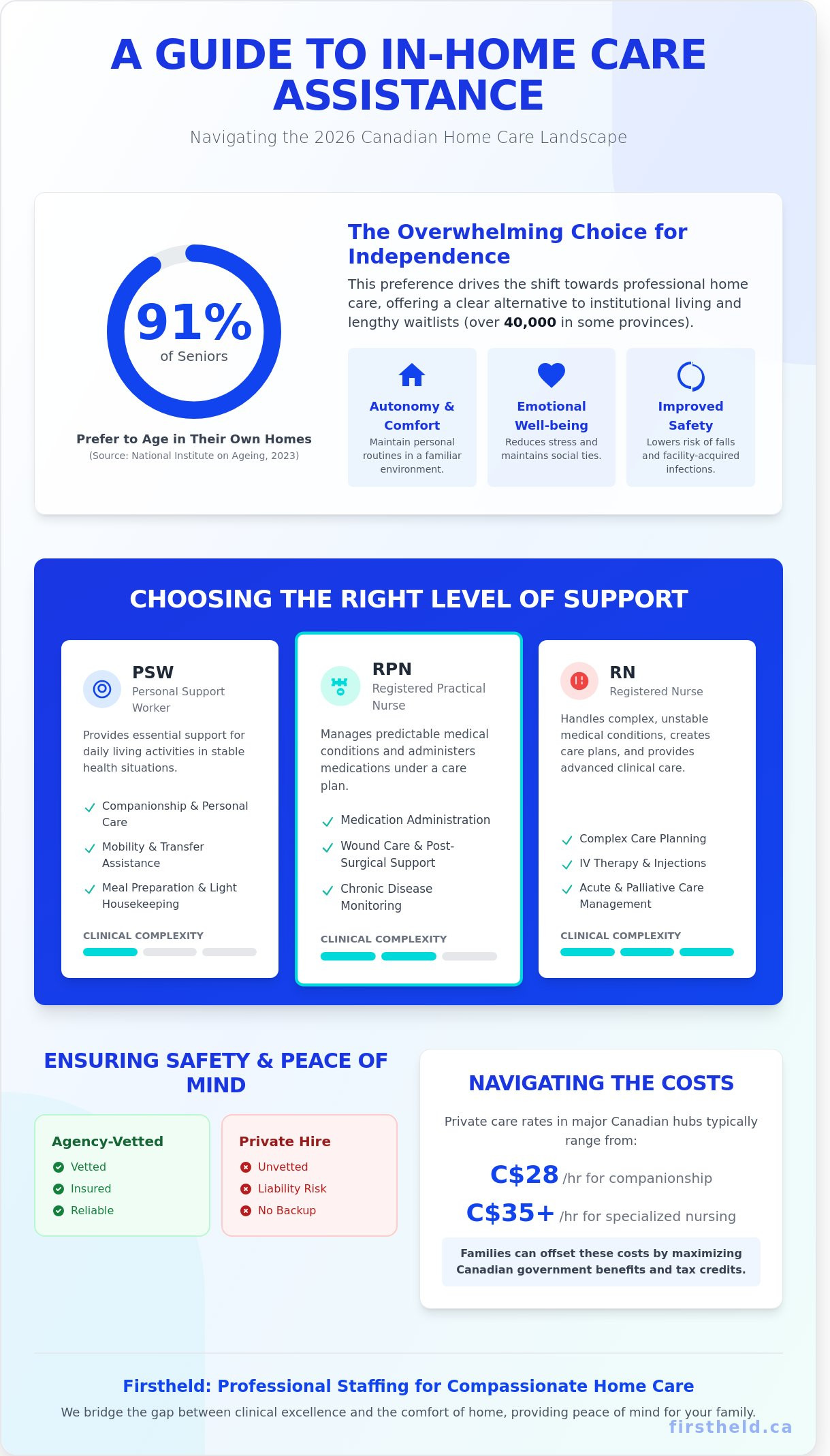
Did you know that 91% of Canadians aged 65 and older intend to live in their own homes for as long as possible, according to a 2023 report from the National Institute on Ageing? This desire for independence often leaves families caught between the exhaustion of caregiver burnout and the fear of a loved one falling while alone. Finding reliable home care assistance shouldn’t feel like a second full-time job. You deserve a solution that balances professional clinical needs with the warmth of a neighborly check-in.
It’s exhausting to manage medication schedules while wondering if the person you hired will actually show up on time. You’ve likely felt the weight of choosing between your career and your parent’s safety. We’ll show you how to secure a safe aging-in-place environment and maximize Canadian government benefits to offset costs that can reach C$35 per hour for specialized support. You’ll learn how to vet professionals who prioritize dignity over just checking boxes.
This guide provides a clear roadmap through the 2026 landscape of in-home support, from understanding private costs to identifying the best local resources for your family.
Key Takeaways
- Distinguish between aging-in-place support and post-hospital recovery to select the most effective care model for your family’s unique needs.
- Identify whether a PSW, RPN, or RN is required by matching clinical complexity with the appropriate level of professional expertise.
- Secure peace of mind by learning why agency-vetted professionals offer superior safety and reliability compared to unverified, “under-the-table” hires.
- Navigate the 2026 financial landscape with a clear look at private home care assistance rates and government funding options across Ontario.
- Discover how Firstheld bridges the gap between clinical excellence and home comfort through specialized, compassionate staffing solutions.
What is Home Care Assistance? Understanding Your Options
Home care assistance is a versatile range of support services delivered directly in your private residence. It’s designed to help individuals live safely and independently. In 2026, this model has become the gold standard for Canadian families. It offers a clear alternative to institutional living. Whether you’re looking for long-term aging-in-place support or short-term post-hospital recovery care, the goal remains the same; keeping you in the environment you love. Staying home provides massive emotional benefits. It reduces the stress of relocation. It maintains social ties with neighbours. Physically, it lowers the risk of facility-acquired infections. Data from the Canadian Institute for Health Information (CIHI) shows that home-based care costs the public system significantly less than hospital beds, leading to a massive push for provincial funding in 2026. This shift reflects a broader global trend defined in this overview of What is Home Care? which highlights how services have evolved from basic aid to complex clinical support.
The transition toward home-based care over long-term care (LTC) facilities is driven by both personal preference and economic reality. By 2026, waitlists for LTC beds in provinces like Ontario and British Columbia have exceeded 40,000 people. This bottleneck has forced a reimagining of how we support our elders. Professional home care assistance isn’t just a backup plan; it’s a proactive choice for those who value autonomy. It allows for a customized schedule that fits your life, rather than forcing you to adapt to the rigid routines of a facility. It’s about empowerment and clarity for the homeowner.
The Spectrum of Care: From Companionship to Nursing
The level of support varies based on specific needs. Non-medical support includes light housekeeping, meal preparation, and social interaction. These services often start around C$28 to C$40 per hour in major Canadian hubs. Personal care moves into more intimate support, such as assistance with bathing, dressing, and mobility, often referred to as Activities of Daily Living (ADLs). Clinical care involves licensed professionals. Registered Nurses (RNs) or Registered Practical Nurses (RPNs) manage wound care, medication administration, and chronic disease management for conditions like heart failure or dementia. This tiered approach ensures you only pay for the level of care you actually need.
Why Families Transition to Professional Assistance
Most families reach a tipping point where unpaid caregiving is no longer sustainable. This often happens after a sudden fall or a missed medication dose. Professional home care assistance provides a safety net that prevents emergency room visits. In Canada, falls cause 85% of senior injury-related hospitalizations. Beyond safety, professional help restores family dynamics. It allows an adult child to be a son or daughter again, rather than a full-time nurse. This shift removes the caregiver burden and replaces it with quality time. It’s a practical solution that values the homeowner’s current assets and comfort over the automated systems of traditional banks or institutions. By 2026, over 25% of Canadian households are expected to utilize some form of professional in home senior care to maintain this balance.
- Companionship: Social visits, grocery shopping, and hobby engagement.
- Personal Care: Help with hygiene, toileting, and transfers.
- Specialized Care: Support for Alzheimer’s, Parkinson’s, or palliative needs.
- Nursing: Medical monitoring, injections, and post-surgical care.
PSW, RPN, or RN: Choosing the Right Level of Support
Selecting the right level of home care assistance isn’t just about finding help. It’s about matching clinical expertise to your family’s specific medical reality. The best choice depends entirely on the complexity and stability of the patient’s condition. In 2024, data from Home Care Ontario indicated that over 700,000 people receive some form of home care daily. Most of these individuals start with a Personal Support Worker (PSW) but may transition to nursing as health needs evolve. Understanding these distinctions ensures you don’t pay for unnecessary clinical oversight while ensuring safety isn’t compromised.
The Canadian Government’s Guide to Home Care provides a framework for these services, yet the practical decision often happens at the kitchen table. You’re looking for a balance between cost, comfort, and clinical safety. Every level of care serves a distinct purpose in the Canadian healthcare ecosystem.
Personal Support Workers (PSW): The Foundation of Home Care
PSWs are the heartbeat of the home care system. They focus on the activities of daily living that maintain dignity and independence. Their primary roles include mobility assistance, hygiene, and nutrition. A PSW ensures a senior can bathe safely, eat balanced meals, and move around the home without the risk of falls. Statistics from 2023 show that falls account for 85 percent of senior injury hospitalizations in Canada; a qualified PSW directly reduces this risk through constant supervision.
These professionals act as the primary “eyes on” the patient. They’re often the first to notice subtle changes in skin integrity, appetite, or cognitive clarity. Firstheld prioritizes compassionate, qualified PSW staffing because we know that consistent care prevents emergency room visits. This proactive approach keeps seniors in their homes longer. If you’re worried about the rising costs of private staffing, you can explore equity-based funding solutions that help cover these essential monthly expenses without the stress of traditional bank audits.
Nursing Care: When Medical Expertise is Essential
Nursing care is required when a patient’s needs move beyond basic physical support into the clinical territory. Registered Practical Nurses (RPNs) and Registered Nurses (RNs) perform tasks that a PSW cannot legally or safely handle. This includes complex wound care, catheter maintenance, and administering injections. According to the College of Nurses of Ontario (CNO) standards, the choice between an RPN and an RN depends on the predictability of the patient’s health outcomes.
- Registered Practical Nurses (RPNs): Best for patients with stable, predictable conditions. They manage medication and chronic wound care with high efficiency.
- Registered Nurses (RNs): Required for complex, unstable, or rapidly changing conditions. This includes advanced palliative care, ventilator management, or acute post-surgical recovery.
- Specialized Care: Both roles are vital for managing Parkinson’s or advanced dementia, where medication timing is critical to patient safety.
Nursing staff in Ontario don’t work in isolation. They coordinate with the broader healthcare team, including family doctors and specialists, to ensure the care plan stays current. By 2026, the demand for specialized in-home nursing is projected to rise by 20 percent as more Canadians choose to age in place. Having a professional who understands the clinical nuances of your loved one’s condition provides a level of security that general support cannot match. It’s about ensuring that every medical intervention is handled with precision and professional accountability.
The Vetting Process: Ensuring Safety and Trust at Home
Inviting a stranger into a loved one’s home is the most significant hurdle for most families. The primary fear is safety. You want to know exactly who is crossing that threshold and what their background entails. While hiring an independent, “under-the-table” worker might seem cheaper, it carries 100% of the liability risk. If a private hire gets injured on the job or lacks proper insurance, the homeowner is often legally responsible for those costs in Canada. Professional agencies remove this burden by providing fully insured, vetted experts.
Every caregiver must pass a set of non-negotiable checks before they ever meet a client. This includes a national criminal record check and a Vulnerable Sector Screening. In Canada, this screening is the gold standard for protecting seniors and vulnerable adults. We also verify that every professional holds current CPR and First Aid certifications. According to 2024 industry reports, 82% of Canadian families cite “peace of mind” as the main reason they choose agency-led home care assistance over private hires. The Canadian Home Care Association provides resources that help families understand these safety benchmarks across different provinces, ensuring that care standards remain high across the country.
Rigorous Screening Standards for Healthcare Staff
We don’t just glance at a resume. Firstheld verifies every educational credential with the original institution. For nursing staff, we confirm active standing with regulatory bodies like the College of Nurses of Ontario (CNO) or provincial equivalents. Reference checks are conducted with a focus on home-based performance. We look for a history of 95% or higher punctuality and positive family feedback. Firstheld staff also undergo mandatory training in 2026 safety protocols, including advanced infection control and fall prevention techniques.
Reliability and Continuity of Care
The “no-show” problem is a major stressor in private care. If a private worker gets sick, your loved one is left alone. Agencies solve this through a robust staffing pool. If a primary caregiver is unavailable, a qualified backup is dispatched within 2 hours. We also match caregivers to clients based on personality and language. In 2025, data showed that clients with matched caregivers had a 40% higher satisfaction rate. This approach ensures home care assistance remains consistent even as care needs increase from basic companionship to complex medical support.
Ongoing monitoring is the final piece of the trust puzzle. We conduct unannounced site visits and monthly performance reviews to ensure standards never slip. This keeps expectations high and ensures that care plans are followed precisely. By choosing a structured vetting process, you replace anxiety with a clear, manageable path forward for your family’s well-being. It’s about more than just filling a shift; it’s about building a partnership based on transparency and professional accountability. For families who want to take control of this process themselves, our comprehensive guide on hiring a senior caregiver with a detailed vetting checklist provides the exact steps to ensure you’re making the safest choice for your loved one.
Navigating the Costs and Financial Support in Canada
Understanding the financial landscape of home care assistance is essential for families in 2026. In Ontario, private home care rates now range from C$38 to C$60 per hour for personal support workers. Specialized nursing care often starts at C$85 per hour. While these figures seem high, they offer a flexible alternative to private retirement residences where monthly fees frequently exceed C$6,200 in the Greater Toronto Area. By staying at home, seniors retain their most valuable asset: their house. Using home equity to fund care is a common strategy for those who want to avoid the rigid structures of institutional living. Waiting for a crisis to occur often leads to rushed, expensive decisions. By analyzing your budget now, you can secure better rates and more reliable staffing for the years ahead.
Publicly funded care through Home and Community Care Support Services (HCCSS) provides a baseline of support at no direct cost. However, wait times for these services are often long and hours are strictly capped based on medical necessity. Most families use a hybrid model. They accept the few hours the government provides and supplement with private agencies to ensure 24/7 safety. Planning for these costs at least five years in advance is a smart move. It allows you to explore how your home’s value can support your lifestyle without draining your daily cash flow. This proactive approach ensures that the quality of care remains high without compromising the family’s long-term financial stability.
Government Benefits and Caregiver Support
The Canadian government offers financial relief for family members who step away from work to provide care. You can access EI caregiver benefits which provide up to 55% of your earnings for a set period. In 2026, the maximum weekly benefit has adjusted to reflect the current cost of living. Locally, Ontario residents should contact their regional HCCSS office to determine eligibility for personal care, physiotherapy, or respite services. The Ontario caregiver tax credit also provides a non-refundable credit for those supporting a spouse or relative with a physical or mental impairment. These programs aim to keep seniors safe at home while reducing the burden on family caregivers.
Tax Credits and Private Insurance
The Medical Expense Tax Credit (METC) is a powerful tool for reducing the net cost of home care assistance. You can claim the salaries paid for home care if the recipient qualifies for the Disability Tax Credit. This often results in thousands of dollars returned during tax season. For a senior with a C$50,000 income, any care costs above C$1,500 could trigger a significant credit. If you have a long-term care insurance policy, review the fine print carefully. Most modern policies require a benefit trigger, such as the inability to perform two activities of daily living like bathing or dressing. Once triggered, these policies pay out an indemnity that you can use to hire staff from private agencies. To maximize value, cluster your care tasks. Having a professional visit for one four-hour block is usually more cost-effective than scheduling multiple short visits throughout the day.
Firstheld: Professional Staffing for Compassionate Home Care
Finding reliable home care assistance shouldn’t feel like a second job for family members. By 2026, data suggests that Ontario families spend an average of 22 hours per week coordinating medical appointments and managing caregiver schedules. This administrative burden often leads to burnout before the actual care even begins. Firstheld serves as the essential bridge between clinical expertise and home-based comfort. We specialize in the placement of Registered Nurses (RN), Registered Practical Nurses (RPN), and Personal Support Workers (PSW) who understand that a home is a place of healing, not just a workplace.
Our staffing model focuses on both high-acuity medical needs and essential daily living support. We take a solution-oriented approach that removes the stress of recruitment from your shoulders. We find the staff so you can focus on family. By vetting every professional through a rigorous 10-point background and clinical competency check, we guarantee that the person entering your home is fully equipped for the task. You aren’t just getting a visitor; you’re getting a dedicated healthcare professional committed to your family’s well-being. We believe that professional support is the foundation of a dignified life at home.
Our Approach to Complex Nursing and Home Support
We maintain a strong local presence across Brampton and the Greater Toronto Area (GTA). In these regions, the demand for specialized home care has risen by 12% since 2024. Firstheld operates as the healthcare equivalent of a direct lender. We manage our staff directly rather than acting as a simple referral agency or a third-party directory. This structure allows us to maintain 100% control over training standards and scheduling reliability. Our team brings deep experience from both busy clinical facilities and private home environments. This dual perspective ensures that complex medical needs, such as wound care or ventilator support, are handled with the same precision you’d expect in a hospital setting. We prioritize the sanctuary of your home while maintaining the highest clinical benchmarks in the province. For families specifically seeking home care services Brampton residents can trust, our local expertise ensures rapid response times and culturally sensitive care that understands the unique needs of this diverse community.
Getting Started with Firstheld Healthcare Staffing
The process of requesting a PSW or Nurse for home support is designed to be fast and transparent. We’ve eliminated the red tape that typically delays home care assistance by up to 14 days in traditional systems. Our team initiates a clinical assessment within 24 hours of your first call to ensure a perfect match between the patient’s needs and the caregiver’s skills. We prioritize professional excellence and speed because we know that health needs don’t wait for business hours. Our staffing plans are flexible, adapting as your loved one’s condition improves or requires more intensive intervention. We provide clear, upfront cost structures in Canadian Dollars, ensuring there are no hidden fees or surprise invoices. You deserve a partner who values your time and your family’s peace of mind. Contact Firstheld for a personalized home care staffing plan to begin your journey toward better home-based care today.
Take Control of Your Home Care Journey
Securing high-quality home care assistance is about more than just filling a schedule; it’s about finding a partner you can trust. You now have the tools to identify whether a PSW, RPN, or RN is right for your family’s unique medical requirements. By prioritizing a rigorous vetting process and understanding the financial landscape in Canada, you ensure safety and long-term stability for your loved ones. Since 2021, Firstheld has served families across Brampton, Peel, and the GTA with a focus on specialized complex nursing care. Our team consists of CNO-registered Nurses and certified PSWs who bring professional authority and neighborly care directly to your doorstep. We strip away the confusion of traditional healthcare bureaucracy to offer fast, simple, and transparent support. Every family deserves the peace of mind that comes from expert medical oversight. It’s possible to maintain independence at home while receiving the precise level of clinical support required. Let’s start building a care plan that looks forward to a healthier, more empowered future.
Request a Qualified Caregiver from Firstheld Today
Frequently Asked Questions
What is the difference between home care and home health care?
Home care provides non-medical support like meal prep and companionship, while home health care involves clinical services from licensed nurses. It’s the difference between lifestyle assistance and medical treatment. Most families start with home care assistance to manage daily tasks and maintain independence. If your loved one needs wound care or physical therapy, you’ll require a specialized home health provider instead.
How much does home care assistance cost per hour in Ontario?
Private home care in Ontario typically costs between C$30 and C$45 per hour in 2026. These rates vary based on the level of specialized support required and your specific city. For instance, specialized dementia care often sits at the higher end of that scale. Budgeting for these costs is simple when you focus on your home’s equity as a flexible funding source.
Can I get government funding for private home care staffing?
You can access government funding through programs like the Ontario Direct Funding program, which currently helps over 1,000 individuals manage their own care budgets. Additionally, the Disability Tax Credit (DTC) provides significant relief during tax season. While these programs help, they often have long waitlists. Many Canadians use home equity solutions to bridge the gap between government support and their actual care needs.
What qualifications should I look for in a home caregiver?
Look for caregivers with a Personal Support Worker (PSW) certificate and valid CPR/First Aid training. A 2025 industry report showed that 85% of reputable agencies now require vulnerable sector police checks for all staff. You should also verify their experience with specific conditions like Alzheimer’s. A qualified professional offers more than just help; they provide safety and peace of mind for your family.
How do I know if my parent needs 24-hour care or just hourly help?
Your parent needs 24-hour care if they experience frequent falls, wandering, or “sundowning” symptoms associated with late-stage dementia. If they only need help with bathing or grocery shopping, 4 to 6 hours of daily help is usually sufficient. Conduct a safety assessment to see if they can safely navigate the home alone at night. We recommend starting with a 20-hour weekly baseline.
What happens if our assigned caregiver is sick or unavailable?
Reputable agencies maintain a pool of backup staff to ensure your care is never interrupted. If your primary caregiver calls in sick, the agency’s coordinator typically assigns a replacement within 2 to 4 hours. This reliability is the main reason families choose established agencies over private hires. You’ll receive a notification immediately so you can prepare your loved one for a new face that day.
Does home care assistance include medical tasks like giving injections?
Standard home care assistance does not include medical tasks like giving injections or managing sterile wound dressings. These tasks are strictly reserved for Registered Practical Nurses (RPNs) or Registered Nurses (RNs) under Ontario law. Home caregivers focus on medication reminders rather than administration. If your parent requires daily insulin shots or IV therapy, you must hire a licensed medical professional through a health agency.
How quickly can home care assistance be started in an emergency?
Most agencies can initiate home care assistance within 24 to 48 hours of an initial assessment. In urgent situations, such as a sudden hospital discharge, some providers offer same-day emergency intake services. Speed is essential to prevent readmission or accidents. Our streamlined approach to funding ensures you have the capital ready to start these vital services the moment a family crisis occurs.
